


Period & Modern Homes in Surrey: Choosing Lighting That Fits the Architecture

Updated: Oct 2
A period home and a contemporary home do not need the same light fittings, but neither should be decorated by a rule book. The best lighting responds first to the architecture: ceiling height, room proportions, original features, furniture layout and how the space is used. Style comes after that.

Illustrative product from our online range. Check the current specification and suitability for your room. View School House Pendant - Satin Silver Metal & Opal Glass on Illuminations Direct.
Should lighting match the age of the house?
Not necessarily. A period room can look excellent with a restrained contemporary fitting, and a modern interior can take a classic chandelier if the scale and finish are right. The aim is not to make every fitting historically correct; it is to make the lighting feel deliberate in the room.
What should I look at before choosing a fitting?
Start with the room rather than the catalogue. Note the ceiling height, ceiling rose or cornice, visible beams, fireplaces, alcoves, glazing, furniture positions and the main viewpoints into the room. Those details tell you far more about the right scale and drop than the age of the property on its own.
Lighting a period room with original features
Original features already give a room visual character, so the lighting does not always need to compete with them. A chandelier, lantern, decorative pendant or pair of wall lights can reinforce the architecture, while a simpler fitting can let ornate plasterwork, panelling or a fireplace remain the focal point.
Can contemporary lighting work in a period home?
Yes. Contrast can be more convincing than imitation. A clean ring pendant, sculptural glass fitting or simple metallic form can sit comfortably in an older room when its size, drop and finish relate to the surrounding architecture. The strongest schemes usually have a reason for the contrast rather than mixing styles at random.
What if the period home has a low or uneven ceiling?
This is where the architecture has to win. Long drops that look attractive in a photograph may simply be wrong for the room. Flush, semi-flush and short-drop fittings can preserve headroom, while wall lights and lamps bring decorative light lower into the space. Our guide to lighting low ceilings covers that subject in detail.
Lighting cottages and smaller rooms
Smaller rooms often benefit from fittings with less visual bulk rather than less character. Clear glass, open frames and compact decorative forms can give presence without making the ceiling feel crowded. Wall lights and table lamps are especially useful because they spread the visual interest around the room instead of asking one ceiling fitting to do everything.
Lighting a modern or recently renovated home
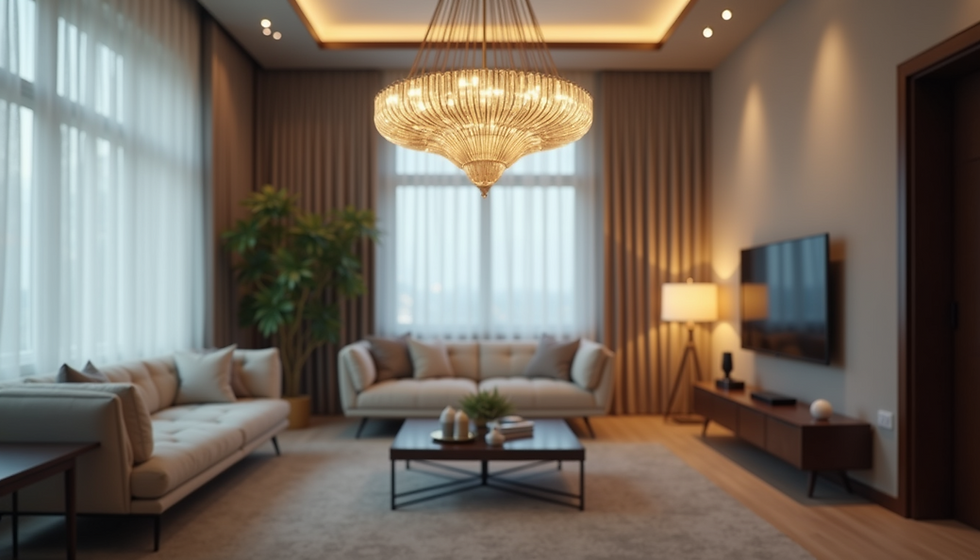
Contemporary rooms often give more freedom with scale, geometry and placement. Linear pendants, sculptural LEDs, clusters and larger statement fittings can work well where the architecture is clean and the sightlines are open. But modern does not have to mean minimal: decorative glass, brass, crystal and textured finishes can stop a new interior feeling flat.
How should I light an open-plan extension?
Treat it as several connected spaces rather than one enormous room. A pendant over the island, a decorative fitting over the dining table and lower-level lamps in the seating area can define different uses without putting up walls. The fittings do not need to match, but they should share enough in finish, shape or light quality to feel related. See our Layered Lighting guide for the underlying principle.
How do I join an old house to a modern extension?
You do not have to choose one style for the whole property. The transition can be part of the design. One approach is to keep a consistent colour temperature or metal finish while allowing the fitting shapes to become progressively more contemporary as you move into the extension. Another is to repeat one material, such as glass or brass, in different forms.
What about high ceilings, vaulted spaces and stairwells?
Modern extensions and remodelled houses can create much taller volumes than the rooms around them. Those spaces need enough vertical presence to look intentional from the ground floor and upper levels. Drop, maintenance access and viewing angle matter as much as diameter. Our High Ceilings & Stairwells guide is the dedicated guide for those spaces.
Do finishes have to match door handles and taps?
No. Matching every metal finish can make a room feel over-coordinated. It is usually more important that repeated finishes look intentional. Brass can sit alongside black, nickel or bronze, for example, if one finish is clearly dominant and the others appear in considered accents.
What colour temperature suits period and modern homes?
The age of the property does not dictate Kelvin. Colour temperature should suit the room, materials and how you use it. Warm light often complements timber, fabrics and traditional finishes, while some contemporary schemes suit a slightly cleaner appearance. The important point is consistency between connected spaces. See our 2700K, 3000K or 4000K guide for the full explanation.
Renovating? Decide the lighting before the walls are finished
If the project still has open walls or ceilings, decide decorative positions, wall-light points, bedside controls, island centres, lamp sockets and switching before those choices become expensive to alter. Our New Build & Renovation lighting guide covers the decisions worth making before first fix is complete.
Can one house mix several lighting styles?
Yes, and most lived-in homes do. The key is repetition rather than uniformity. Repeating a finish, glass type, curve, colour temperature or level of decoration can make quite different fittings feel as though they belong to the same home.
See how decorative lighting behaves in real homes
Product photography removes the room around the fitting. Real installations show scale, ceiling height, furniture, daylight and neighbouring finishes at the same time. Our Customer Installations page contains real examples from homes across Surrey, Berkshire and Hampshire.
What should I bring to the showroom?
Bring photographs of the room from more than one angle, floor-to-ceiling height, approximate room dimensions and measurements of any table, island or furniture the fitting needs to relate to. If original features or a new extension are important to the scheme, include those in the photographs too.
Choosing lighting for a Surrey home
The useful question is not ‘Is this fitting period or modern?’ It is ‘Does it belong in this particular room?’ Seeing decorative lighting switched on makes that judgement much easier because you can compare scale, finish, sparkle, glare and the quality of light before committing.
Illuminations of Camberley · 66–68 High Street, Camberley, Surrey GU15 3RS · Monday–Saturday 9am–5:30pm · No appointment needed. Why visiting a lighting showroom changes everything.
Shop this advice
Ready to look at fittings? Browse the relevant Illuminations Direct collections, then collect from our Camberley showroom:


Comments