


How to Size a Pendant or Chandelier for Your Room

Updated: Sep 9
The right chandelier or pendant should look as though it belongs to the room, not as though it has simply been fitted into the available ceiling point. Size is influenced by the room, the furniture beneath it, ceiling height and the visual weight of the fitting itself. The measurements below are useful starting points, but they work best when considered together rather than as rigid rules.

What size chandelier or pendant do I need for a room?
A commonly used starting point is to measure the room in feet, add the length and width together, and read that total as an approximate fitting diameter in inches. A 12ft by 14ft room gives 26, suggesting a fitting around 26 inches (about 66cm) across.
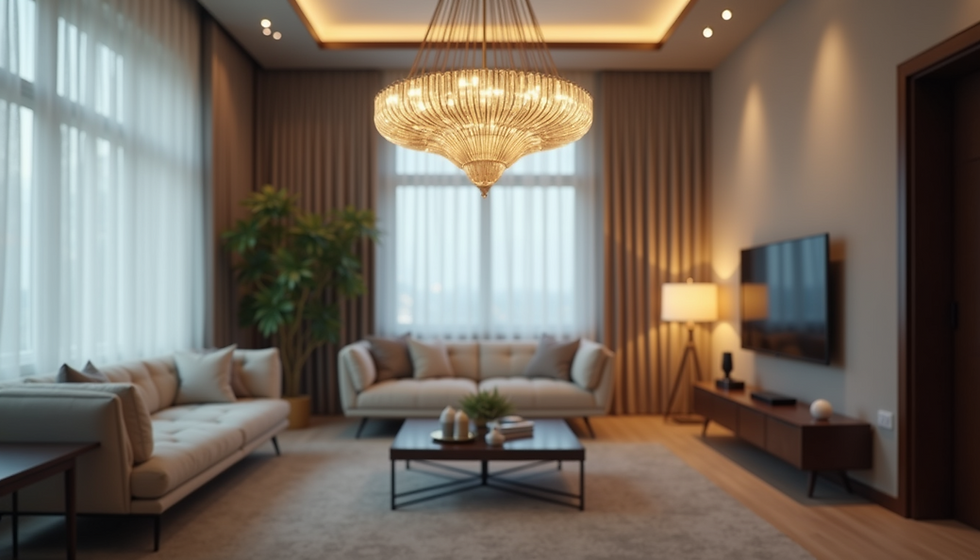
Treat that as a sense-check, not a design law. A transparent glass fitting can look much lighter in the room than an opaque metal fitting of the same diameter, while a dense crystal chandelier can have much more visual presence. Furniture, ceiling height and how open the room feels can all justify moving larger or smaller than the formula suggests.
Why visual weight matters as much as diameter
Two fittings can measure exactly the same width and still feel completely different in a room. Clear glass, fine arms and open frameworks allow you to see through the fitting, so they often tolerate more scale. Solid shades, dark finishes and dense decorative detail tend to look heavier. This is one reason decorative lighting is difficult to judge from a product photograph alone.

How wide should a chandelier be over a dining table?
The fitting should normally sit comfortably within the width of the table rather than extending beyond it. A useful starting point is to leave visible table width on both sides of the chandelier or pendant, but the exact amount depends on the shape of both the table and the fitting.
For example, a long rectangular table often suits a linear fitting or a pair of pendants better than one very wide round chandelier. A round table can work particularly well with a central circular or multi-arm fitting. The aim is for the light and the furniture beneath it to read as one composition.
How high should a chandelier hang above a dining table?
Around 75–85cm from the tabletop to the lowest part of the fitting is a useful starting point for many homes. The final height should also take account of the chandelier's size, the ceiling height and the sightlines of people sitting and standing around the table.
The fitting should feel connected to the table without blocking conversation or views across it. Larger fittings can often sit a little higher and still feel substantial; smaller decorative fittings may look better slightly lower.

How do I calculate the overall pendant drop?
Subtract the table height and your chosen clearance above the table from the ceiling height. For example: a 240cm ceiling minus a 75cm-high table minus an 80cm clearance leaves an overall drop of 85cm, measured from the ceiling to the lowest part of the fitting.
This is a worked measurement example, not a recommended height for every home. Check that 85cm falls within the product's stated minimum and maximum overall drop. The ceiling rose, suspension and decorative body all need to fit within that space; the body height alone is not the overall drop. Confirm the manufacturer's drawing before ordering.
Should the chandelier be centred in the room or over the table?
If the chandelier is intended to light and visually anchor a dining table, the table is usually the more important reference point. In open-plan rooms, furniture often defines the lighting zones more successfully than the geometric centre of the ceiling. This is especially relevant where the dining table sits to one side of a larger kitchen or living area.
What if my ceiling is low?
With a lower ceiling, check the fitting's minimum drop before buying. A pendant may be adjustable enough to work, but a flush or semi-flush design can give you more comfortable clearance while still providing decorative interest. The description 'pendant' on its own does not tell you whether the fitting will suit your ceiling—the minimum overall height is the figure that matters.
For help choosing between flush, semi-flush and short-drop fittings, see our lighting for low ceilings guide.
What about high ceilings and stairwells?
High ceilings allow more drop, but the question is not simply how long the fitting can be. It also needs enough scale to be seen from the main viewpoints in the room. In a stairwell or double-height space, consider how the fitting looks from both floors and whether the decorative part sits in the part of the void where it can actually be appreciated.
For placement, viewpoints and access in taller spaces, see our high ceilings and stairwells guide.

Can a chandelier be too small?
Yes. One of the most common scale problems is choosing a decorative fitting that looked substantial in a close-up photograph but feels undersized once it is installed in the room. Before ordering, compare the fitting diameter with something familiar in the room or mark the approximate width with tape so you can see the scale in context.
Can a chandelier be too large?
It can, particularly where it crowds doors, sightlines or nearby furniture. But visual weight matters here too: an open glass or fine-framed fitting can occupy a large physical diameter without dominating the room in the same way as a dense opaque design.
Does the number of lights determine the right size?
Not by itself. A five-light chandelier is not automatically larger or more suitable than a three-light fitting. Compare the actual diameter, height, minimum and maximum drop, lamp type and light output rather than relying on the lamp count in the product name.
What measurements should I take before choosing?
Bring the room length and width, floor-to-ceiling height, the dimensions of any table or island beneath the fitting, and photographs showing the room from more than one angle. If there is an existing ceiling point, note where it sits in relation to the furniture. Those measurements give us a much better basis for advice than the room size alone.
The Illuminations view on sizing
We use formulas as a starting point, but we would not choose a chandelier from a formula alone. Decorative lighting has proportion, depth, finish, glass, reflections and visual weight that are difficult to reduce to one number. Seeing a fitting hung and illuminated at full scale often changes how large or small it feels.
If you are unsure, bring your room measurements, table dimensions, photographs or plans to Illuminations of Camberley. We can compare the fitting's real dimensions with your space and help you decide whether the scale and drop will work before you buy.
Illuminations of Camberley, 66–68 High Street, Camberley, Surrey GU15 3RS. Open Monday–Saturday, 9:00am–5:30pm.
Shop this advice
Ready to look at fittings? Browse the relevant Illuminations Direct collections, then collect from our Camberley showroom:
Bring your project to the showroom
Planning a room or renovation? Read about our free showroom lighting-planning help and send photographs, plans, ceiling heights and measurements before you visit.
Updated 9 September 2026. Sizing suggestions are practical starting points; final dimensions depend on the room, furniture and the fitting's installation instructions.


Comments