


Integrated LED vs Replaceable Bulbs: Which Light Fitting Is Better?

Updated: Oct 4
Integrated LED fittings and fittings with replaceable bulbs can both be excellent choices. Neither is automatically better. Integrated LED gives designers more freedom to create slim shapes, continuous light and compact forms. A fitting with a conventional lamp holder gives you more freedom later: the bulb can usually be replaced, and you can often change brightness, colour temperature or lamp style without changing the fitting.
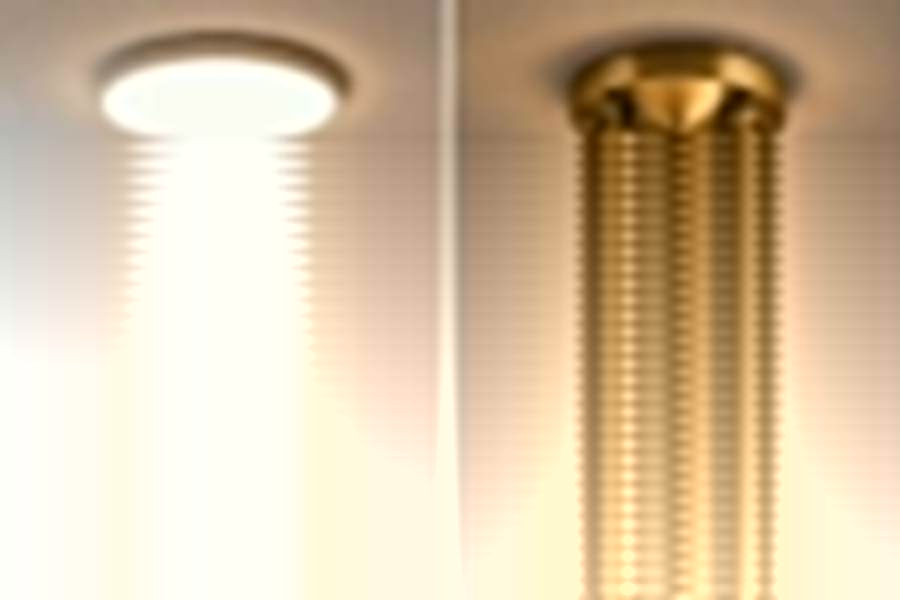
What is an integrated LED light fitting?
An integrated LED fitting has the LED light source built into the luminaire rather than relying on a separate household bulb. The LEDs normally work with electronic control gear or a driver designed as part of the fitting. Because the manufacturer is designing the light source and fitting together, the LEDs can be arranged in ways that would be difficult with a conventional bulb.
What is a fitting with a lamp holder?
A lamp-holder fitting uses a replaceable lamp — what most customers simply call a bulb. Depending on the design this might be an E27, E14, G9, GU10 or another lamp type. The fitting provides the decorative structure and electrical connection, while the chosen lamp determines much of the brightness, colour temperature and dimming behaviour.
The main advantage of integrated LED: design freedom
Integrated LED allows manufacturers to design around the light itself rather than around the physical size of a bulb. That is why very slim rings, shallow ceiling fittings, sculptural pendants and continuous illuminated lines are commonly integrated LED. If the design would be impossible to achieve neatly around a replaceable bulb, integrated LED may be the better solution.
Integrated LED can give more controlled, even light
Because LEDs can be distributed across a fitting, integrated designs can spread light over a larger area rather than concentrating it at one lamp position. Diffusers and optical components can also be designed around that exact LED arrangement. This does not mean every integrated fitting is better, but it gives the designer more control over how the complete fitting produces light.
The biggest question with integrated LED: what happens if it fails?
This is the question we think customers should ask before buying. With some integrated fittings, the LED module or driver can be replaced as a spare part. With others, repair may be difficult or uneconomic, particularly years later if the exact component is no longer available. Integrated LED should therefore be judged not only on its quoted life, but also on the manufacturer's warranty, spare-parts policy and whether the driver or LED module is serviceable.
Think about the LED television in your home
A useful comparison is the television in your home. You probably have a large LED TV, but when you bought it you probably did not ask the salesperson, ‘What happens if one of the LEDs fails?’ You accepted that the LEDs were built into the product because they are designed to last a long time. Integrated LED lighting works on a similar principle: the light source is part of the fitting rather than a bulb you expect to replace routinely.
That does not mean an integrated LED fitting can never fail. The difference is that a television is usually treated as a complete product, whereas a decorative light may be something you hope to keep for 15 or 20 years. That is why manufacturer quality, warranty, spare-parts support and serviceability still matter — particularly on an expensive fitting.
Does integrated LED mean the whole fitting must be thrown away if it fails?
Not necessarily. Some products are designed so a driver or LED module can be serviced or replaced; others are much less repair-friendly. The important point is not to assume either outcome from the words ‘integrated LED’. If long-term repairability matters to you, ask how the product is constructed and what support the manufacturer offers.
The main advantage of a lamp-holder fitting: easy replacement
With a conventional lamp holder, the light source is normally the easiest part of the fitting to replace. If a bulb fails, you replace the bulb rather than the decorative fitting. For customers who want to keep a chandelier, pendant or wall light for many years, that simplicity is a strong advantage.
Replaceable bulbs also give you more flexibility
A lamp-holder fitting lets you change the character of the light later. Subject to the fitting's specification, you can often choose a different lumen output, colour temperature, lamp shape or dimmable LED lamp. That can be useful if a room changes use, if you decide the original light is too warm or too cool, or if LED technology improves while you still like the fitting itself.
What are the disadvantages of replaceable bulbs?
The fitting has to be designed around the lamp, so the bulb can dictate the scale and shape of parts of the luminaire. Exposed lamps can also create glare if the wrong bulb is chosen, and multi-lamp fittings depend on all the lamps matching reasonably well in colour and output. The final performance is therefore partly down to the bulb you put into the fitting, not just the fitting itself.
Which is more energy efficient?
Do not assume that ‘integrated LED’ automatically means efficient and ‘lamp holder’ means inefficient. A lamp-holder fitting using modern LED bulbs can also use very little power. The more useful comparison is the performance of the complete lighting solution: useful lumen output, power consumption, optics, driver efficiency and how much of the produced light actually reaches the room. The UK Energy Technology List also evaluates efficient lighting as a complete unit rather than treating one component in isolation. Read the Energy Technology List lighting guidance.
Which gives me more choice over colour temperature?
A replaceable-lamp fitting usually gives you greater freedom because you can change the bulb later. With most integrated LED fittings, the colour temperature is fixed by the product unless the fitting has a selectable or tunable-white feature. If you are unsure whether you prefer 2700K, 3000K or 4000K, it is worth deciding that before buying an integrated fitting. Our colour-temperature guide explains the differences.
Which is easier to dim?
Neither category guarantees good dimming. With integrated LED, the built-in driver must support the type of dimming you intend to use. With a lamp-holder fitting, the LED bulbs themselves must be dimmable and compatible with the dimmer. In both cases the exact combination matters. See our LED Dimming & Flicker guide before assuming a fitting will dim smoothly.
Which is better for chandeliers and decorative pendants?
For classic chandeliers and designs where the lamps form part of the visual character, replaceable lamp holders often make sense. For ultra-slim, sculptural or continuous-light pendants, integrated LED may make the design possible in the first place. Decorative lighting is one of the clearest examples of why there is no universal winner.
Which is better for a fitting I want to keep for 15 or 20 years?
If your priority is straightforward long-term serviceability, a conventional lamp-holder fitting has an obvious advantage because the light source is designed to be replaced. An integrated fitting can still be a good long-term purchase, but we would put more weight on manufacturer quality, warranty, spare parts and whether the driver or LED module can be serviced.
What should I ask before buying an integrated LED fitting?
Ask whether it is dimmable, what colour temperature it produces, its lumen output, what warranty applies, whether the driver or LED module is replaceable, and what happens if a component fails outside warranty. A good product specification should make the first three clear; the serviceability questions are worth asking when the fitting is an important or expensive part of the room.
What should I ask before buying a lamp-holder fitting?
Check the lamp-cap type, number of lamps, maximum permitted wattage, whether the fitting is suitable for LED lamps and what bulb shape will physically fit. Then choose the lamp by lumens and colour temperature rather than simply copying the wattage of an old incandescent bulb. Our Lumens & Brightness guide can help with that.
So which would we choose?
For a fitting where the integrated technology creates a genuinely better design — a slim ring, sculptural pendant or even spread of light — we would not reject it simply because the LEDs are built in. But where two fittings look equally good and long-term simplicity is the priority, the replaceable-lamp option has a strong practical advantage. The right answer depends on what matters most in that particular room.
See both types lit before you decide
This is easier to understand in person than from specifications alone. An integrated fitting and a lamp-holder fitting can have similar quoted outputs but look very different once switched on because the distribution, diffuser, glass and direction of light are different. At Illuminations of Camberley you can compare decorative lighting lit and working before deciding which approach suits your room. For help comparing the options for your room, use our free showroom lighting-planning service.
Illuminations of Camberley · 66–68 High Street, Camberley, Surrey GU15 3RS · Monday–Saturday 9am–5:30pm. Buy the light, not the photograph.
Shop this advice
Ready to look at fittings? Browse the relevant Illuminations Direct collections, then collect from our Camberley showroom:
Review and primary sources
Reviewed by Illuminations of Camberley on 21 August 2026. This guide combines practical experience from displaying and advising on decorative lighting with the primary guidance below. Product specifications and electrical requirements should always be checked for the individual fitting and installation.
Comments